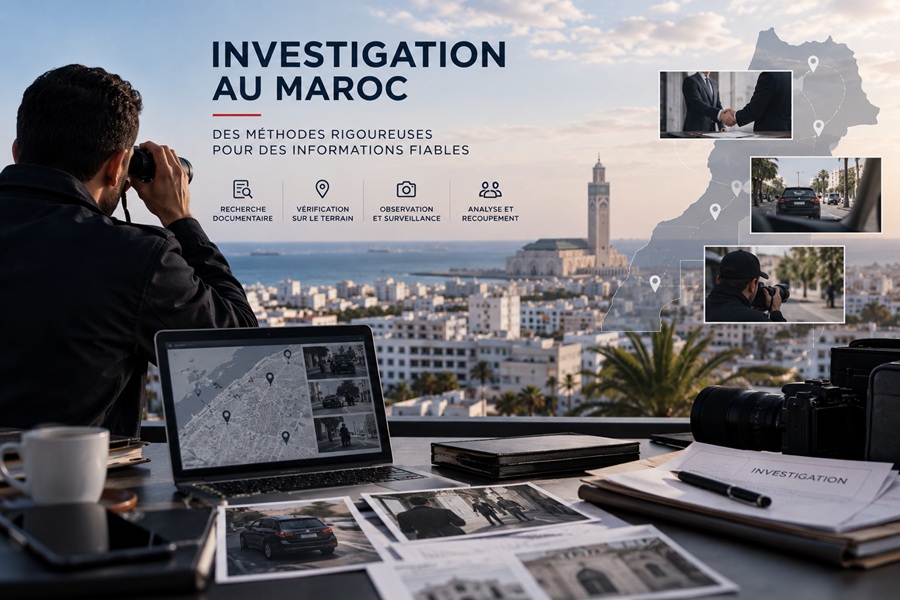
#Investigations in Morocco: Methods for Verifying the Facts
a private investigation in Morocco can use several methods: documentary research, field audits, observation, monitoring or discreet surveillance. Their use depends on the nature of the facts sought, the information already available and the applicable legal framework.
Not all situations require the same means. A search for professional information can be carried out from accessible documents, while verification of certain material facts may require intervention in the field.
The main point is not to increase the number of investigative techniques, but to choose which ones can provide reliable and relevant information.
The main methods of private investigation in Morocco
Documentary research and digital investigation
The literature search is used to examine information available in accessible documents, registers, professional publications or online sources.
In particular, it may help to verify the existence of an undertaking, examine certain professional information or identify inconsistencies in the elements communicated.
However, the information available on the Internet has several limitations:
- A data may be old or no longer relevant to the current situation.
- Several people may have the same name.
- A publication may be incomplete or out of context.
- Repeated information on multiple sites may come from a single initial source.
Therefore, the presence of information on several sites does not necessarily constitute independent confirmation.
Field investigations and audits
Some situations require comparing available information with the reality of the field.
An audit may, for example, cover the existence of an establishment at a declared address or certain directly observable material elements.
Information may also be collected from persons who freely agree to disclose it, within the applicable legal limits.
It is essential to distinguish a direct observation from a third-party statement. These two categories of information do not offer the same degree of certainty.
Observation and monitoring
Observation can be used to document a specific situation where one-time or documentary verification is not sufficient.
Its interest depends on the question to be resolved, the place concerned and the conditions under which facts can be legally established.
A time-limited observation does not necessarily make it possible to draw a general conclusion about an individual's habits or activities.
Finding a fact at a given time does not mean that it is systematically repeated.
Filament
Discreet surveillance is a particular method of observation, which can be considered when verifying certain facts requiring the monitoring of movements under legally permissible conditions.
It is not suitable for all missions and should not be used systematically.
Its interest depends on the relevance of the facts sought, the circumstances and the possibility of conducting the intervention without prejudice to the rights of the persons concerned.
A discreet surveillance may also produce no evidence to confirm the initial hypothesis.
How to assess the reliability of information collected?
An investigation is not limited to obtaining information. Still, it is necessary to determine what they actually do.
Several criteria need to be considered.
The origin of information
Does information come from an identifiable document, direct observation or declaration?
Its provenance influences the necessary additional checks.
What's new?
Accurate information several years ago may no longer correspond to the current situation.
This includes addresses, professional functions and business activities.
Identification
A correspondence of name, photograph or address is not always sufficient to establish that it is the right person or business.
The risks of homonymousness and confusion should be taken into account.
Its substantiation
Important information becomes more reliable when it is confirmed by other relevant and independent elements.
However, several publications with the same assertion should not be confused with several independent confirmations.
Its context
A fact can be real while being misinterpreted.
For example, finding that an establishment is closed during a crossing is not sufficient to conclude that the enterprise has definitively ceased its business.
Reliable information is information whose source, context and limitations are known.
What mistakes can compromise an investigation?
Some errors may lead to inaccurate conclusions, even when the information collected seems convincing.
Search only to confirm suspicion
Where an investigation is based on an initial hypothesis, there is a risk of favouring the elements that appear to confirm it.
A rigorous approach must also examine the information that contradicts it.
Consolidating declaration and finding
A person may report a situation without having witnessed it directly. His testimony must be appreciated in the light of this limitation.
Draw a conclusion from one element
A photograph, publication or ad hoc observation may provide useful information but does not necessarily establish all the circumstances.
Ignore conflicting information
A contradiction is not always evidence of an irregularity. It may result from an error, outdated information or insufficiently understood context.
However, it is a point to be considered before concluding.
What are the legal limits of investigative techniques?
The methods of private investigation must comply with the rules applicable in Morocco, particularly those relating to privacy and the protection of personal data.
Law No. 09-08 regulates the processing of personal data. Depending on the circumstances, research and use of collected information may also raise other legal issues.
The use of a private investigator does not give access to the powers reserved for public authorities.
It alone does not permit the interception of private communications, access to protected accounts or obtaining confidential data without legal basis.
The possibility of gathering information must also be distinguished from its possible admissibility in judicial proceedings.
An investigation method is not justified solely because it would provide useful information.
What can a private investigation really do?
The outcome of an investigation depends on the facts sought and the information that can be obtained and verified.
An investigation can lead to several situations:
| Result | What it means |
|---|---|
| Reported | One element was directly observed or documented. |
| Substantiated information | A number of sufficiently reliable elements support the same conclusion. |
| Information not confirmed | The available checks do not make it possible to conclude. |
| Contradictory information | Divergent elements require further analysis. |
| Verification impossible | The legally available means or circumstances do not allow the fact sought to be established. |
It is important to clarify that unconfirmed information is not necessarily false.
Similarly, the absence of a finding does not automatically constitute proof that an event did not occur.
The return of the results must allow the client to understand what has been established, which remains uncertain and the limits of the research carried out.
A method adapted to each investigation in Morocco
Documentary research, field audit and discreet surveillance meet different needs. Their relevance depends on the question asked and the circumstances of the mission.
Since 2009, Maroc Investigation, a private detective agency based in Casablanca, intervenes in research and verification missions for individuals and professionals.
Do you want to understand the possibilities of an investigation in your situation?
Contact Maroc Investigation to present the facts you wish to verify. We will be able to examine the nature of your application, its feasibility and possible means within the applicable framework.