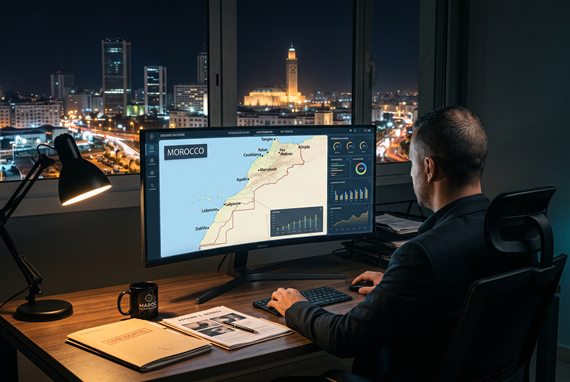
#Private Investigators in Morocco: Casablanca, Rabat and Marrakech
When you need a private investigator in Morocco to check information or facts that are difficult to verify independently, the first question should be: what can a private investigation actually provide?
The matter may involve a business partner before a joint venture, information about a person or company, an event requiring checks on the ground, or a professional or commercial situation in which information must be gathered and compared before an important decision.
Private investigation does not mean gaining access to every kind of information. Its value lies in understanding what can be researched, how it can be verified and the limits of the methods used.
A sound investigation therefore begins by understanding the client's needs and defining the question that requires a clear answer.
What does a private investigator in Morocco do?
A private investigator is a professional engaged to gather information and verify facts within a specific assignment for an individual or a business.
Depending on the case, an assignment may involve professional or commercial enquiries, checking information about a person or organisation, field investigations or gathering indications that help the client understand a situation.
The work goes beyond collecting information. Often, its real value lies in comparing the available information, checking how closely it reflects reality and identifying points that need further investigation.
An investigator does not make decisions for the client. Their role is to provide information that helps the client make a better-informed decision.
When can a private investigator be useful?
Not every problem requires a private investigation. However, enquiries can be useful when information is incomplete or contradictory, or when a decision is important enough to justify independent checks.
Before entering a business partnership
Before setting up a company, entering a partnership or investing a substantial sum, an entrepreneur may wish to learn more about the person or organisation involved.
Depending on the assignment, enquiries may focus on:
- Professional and business history;
- Known or declared activities;
- Companies or commercial interests relevant to the assignment;
- Available information about professional and commercial reputation;
- Verification of facts on the ground;
- Comparison of information provided to the client with information that can be independently verified.
The aim is not to find a reason to reject the partnership, but to reduce uncertainty before making a decision.
Commercial and professional matters
Businesses may also commission investigations when a situation requires further verification.
For example, this might involve gathering indications about a business activity, checking professional information, establishing what is happening on the ground or collecting information before taking administrative or legal action.
A distinction must be made between information that has been found and information that can be independently verified. This distinction is fundamental to a professional investigation.
When the available information is contradictory
In some cases, the problem is not a lack of information but conflicting accounts or information about the same subject.
The investigator may seek additional facts to compare the accounts and identify points of agreement or contradiction, rather than relying on a single source.
What can a private investigator in Morocco verify?
Every assignment is different, so there is no fixed list that applies to all cases.
Generally, investigations can address information and facts that can be researched or verified through lawful methods appropriate to the assignment.
Professional and commercial information
Depending on the case, enquiries may cover a person's or company's professional or commercial activity, business interests relevant to the case and information from sources that can lawfully be accessed.
Published information is not necessarily accurate. Verification and comparison remain essential parts of the work.
Checks on the ground
Online information and available documents are not always sufficient.
It may be necessary to verify conditions on the ground, such as whether a business operates at a location, the nature of a site or other facts relevant to the assignment.
Field checks can be particularly useful when information on paper differs from the reality the client needs to understand.
Comparing information
A person may provide information about their business or professional circumstances while other sources suggest a different picture.
In such cases, the investigator's role is not simply to gather as much data as possible, but to compare the available evidence and seek a more coherent understanding of the facts.
Can a private investigator access bank accounts or confidential information?
A private investigator has no general authority to access private bank accounts or obtain confidential banking information without a legal basis or permission from the competent authority where required.
Banking information and personal data are subject to privacy, confidentiality and data protection rules.
When assessing financial or business circumstances, investigators must therefore rely on information and indicators obtained lawfully, rather than unauthorised access to protected accounts or files.
The same principle applies to passwords, private accounts, protected databases and personal correspondence.
Professional investigation does not mean that every piece of information is accessible to the investigator.
Can investigation findings be used in legal proceedings?
The findings of a lawfully conducted investigation may form part of the material a client shares with a lawyer or submits in a case, depending on its nature.
However, it is important not to suggest that every private investigator's report is automatically admissible in court.
The significance of each item, how it may be used and the weight it carries depend on the dispute, the facts, the applicable procedural rules and the assessment of the competent courts.
If an investigation is intended to support legal action, that objective should be established at the outset so that information gathering and reporting are appropriate to the case.
The investigator gathers, verifies and documents what can be documented within the assignment. Legal assessment of the findings and decisions about their use remain matters for the client, their legal adviser and the competent authorities.
How does a private investigator differ from the police?
The police and security authorities exercise statutory powers connected to their duties, particularly investigating crime and enforcing the law.
A private investigator, by contrast, works under instructions from a client seeking to verify specific facts or information.
Private investigators therefore do not have police or judicial powers.
Simply being an investigator does not authorise someone to compel answers, search a home, access a protected information system or obtain confidential data without a lawful basis.
Clients should understand this distinction from the outset: what a private investigation can achieve and what requires an official or specialist authority.
Private investigators in Casablanca
Casablanca has a high concentration of economic activity, trade and businesses, so private investigations there may often involve professional or commercial matters.
A company owner may need to check information before a partnership, understand facts relating to a business activity or commission field enquiries on a specific issue.
The aim is not to collect general information about a person or company, but to answer a clear question:
What do I need to know before making this decision?
That question determines the scope of the investigation, the methods that may be used and the results that can reasonably be expected.
Private investigators in Rabat
Private investigations in Rabat may concern personal, professional or commercial matters, depending on the client's needs.
The assignment may be to verify specific information, clarify facts about a person or organisation, carry out field enquiries or gather additional material before a decision.
Here too, the assignment begins with a precise objective.
The clearer the question, the easier it is to define the investigation's scope and avoid unfocused research into unrelated information.
Private investigators in Marrakech
Marrakech has diverse economic, commercial, tourism and property activities, which can create different needs for private investigation.
An assignment might involve checking a partner or project, researching professional and commercial information or verifying facts on the ground concerning a person or organisation.
As in Casablanca and Rabat, the approach depends on the assignment, the information sought and the methods that may lawfully be used.
Working in Marrakech does not change the fundamental principles: define the question, collect relevant information, verify it and present the findings clearly.
How does a private investigation agency carry out an assignment?
There is no single method for every case, but an assignment can usually be divided into clear stages.
1. Understanding the client's needs
An assignment begins with understanding the problem, not collecting information.
What happened? What do you want to verify? What decision will you make based on the findings?
These questions help define the scope of the work.
2. Defining the scope of the investigation
Once the need is understood, the relevant information and suitable research methods are identified.
This stage helps prevent unnecessary expansion of the investigation.
3. Gathering information
The investigator uses sources and methods appropriate to the case.
Some information may come from public sources, while other cases require field enquiries or additional checks.
4. Verification and comparison
Not every piece of information is treated as an established fact.
Where possible, information is compared and assessed alongside the other facts available in the case.
5. Organising the findings
At the end of the assignment, the client needs to know what has been verified, what could not be confirmed and which points require further checks.
A good report does not merely collect information; it helps the client understand it.
Confidentiality and privacy in private investigations
The nature of certain cases makes information shared by the client or gathered during the assignment sensitive.
It must therefore be handled professionally, with due regard for privacy, data protection and confidentiality rules.
The scope of the assignment should be clear from the outset, particularly when personal information is involved.
Confidentiality does not mean breaking rules to obtain protected information. It means responsibly handling information obtained within the scope of the assignment.
What can a private investigator not do?
Clients should understand the limits of an investigation before engaging an agency.
A client's instructions alone do not authorise a private investigator to:
- Hack email or social media accounts;
- Obtain passwords;
- Access private bank accounts;
- Access databases without authorisation;
- Unlawfully intercept communications;
- Impersonate a public official to obtain information;
- Force someone to provide information the investigator has no authority to demand;
- Exercise police or judicial powers without a legal basis.
These limits do not make an investigation less useful.
On the contrary, understanding what can and cannot be done helps define a realistic, clear and feasible investigation from the outset.
How do you choose a private investigation agency in Morocco?
Before engaging an investigator or agency, it is useful to ask a few straightforward questions.
Has the agency understood my problem?
The agency should understand the actual question, not just the general subject.
Has it explained what it can do?
A professional agency makes the limits clear from the outset, rather than promising access to any information regardless of its nature.
Is the assignment clearly defined?
The clearer the assignment, the easier it is to assess the results, cost and time required.
How will the information be handled?
It is important to understand how information gathered during the investigation will be handled, especially personal or sensitive data.
Are the promises realistic?
Be cautious of anyone promising rapid access to bank accounts, passwords, confidential records or protected databases.
Professionalism is measured by the ability to identify what can actually be verified, not by promises of access to everything.
Why do individuals and businesses use private investigators?
Reasons vary, but most cases share one factor: the need to reduce uncertainty before making a decision.
For individuals, this may involve checking a person, an event or information that is difficult to verify independently.
For businesses, the aim may be to understand professional or commercial circumstances, verify information before a partnership or gather facts to assess particular risks.
An investigation is not a substitute for a decision.
It supplies information and findings within the assignment's scope; evaluating them and deciding what to do remain the client's responsibility.
When is a private investigation genuinely useful?
An investigation is most useful when you have a specific question that needs an answer.
For example, instead of saying:
“I want to know everything about this person.”
It is better to define the need:
“I want to verify information about their business before entering a partnership.”
Or:
“I want to establish certain facts before making an important decision.”
The distinction matters.
An investigator cannot effectively research “everything”. They can work more precisely when they understand what the client needs to know, why they need it and which decision depends on that information.
Private investigators in Morocco: establishing the facts before a decision
Engaging a private investigator does not mean seeking confidential information by any means, nor does it confer police or judicial powers.
Private investigation is primarily a process of research and verification designed to help a client understand a situation better.
Whether you are in Casablanca, Rabat, Marrakech or another Moroccan city, the right starting point is to define the question you want answered.
If you have conflicting information, doubts that need checking or an important decision requiring additional facts, the feasibility of a private investigation can be assessed according to the circumstances and the methods lawfully available.
The investigator researches and verifies. The client decides.
If you have a specific situation and want to know whether a private investigation is appropriate, contact Maroc Investigation and briefly explain your needs so that the possible scope of an assignment can be determined.