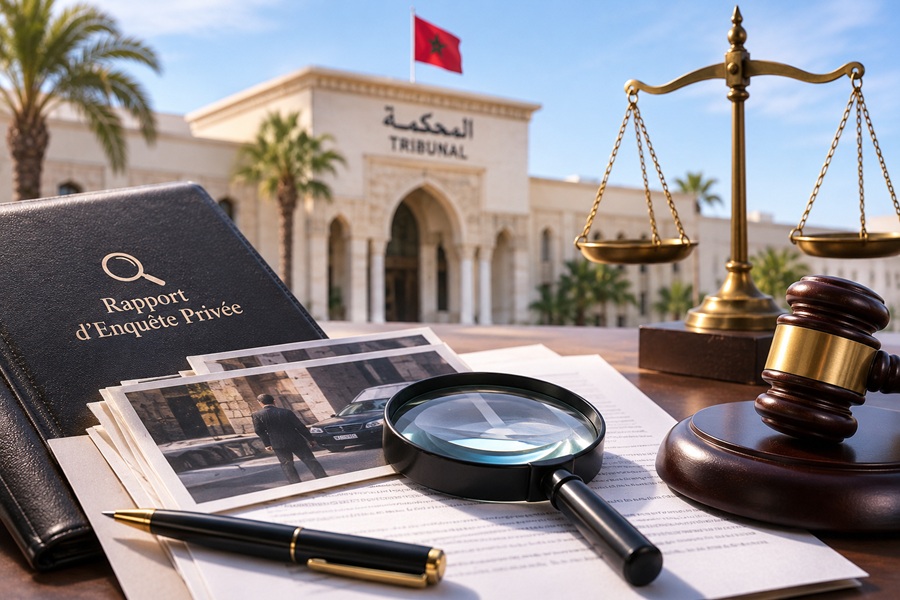
#Internal Theft in Moroccan Companies: Investigating and Establishing the Facts
A computer disappears. Unexplained difference in stock. Goods that no longer correspond to inventories. A body with regular deviations. Or even material that comes out of the company without any clear trace to explain its destination.
All companies can face this type of situation some day or another.
The problem, however, is not always to know that something is missing. The real problem begins when the company does not know what happened, how it happened and who might be involved.
In this context, doubt can quickly arise. Is an employee really responsible? Is this a mismanagement, negligence, procedural malfunction or actual internal flight?
Before accusing anyone, it is therefore essential to look for facts.
It is precisely in this type of situation that a professional survey can be considered, particularly when an enterprise wishes to have an outside look to verify concrete elements and understand the origin of an anomaly.
What is an internal business flight?
It is generally referred to as internal theft when a property owned by the company disappears or is removed in the course of its activity, with possible involvement of an individual having access to the enterprise, its premises, inventory or resources.
The term therefore does not concern only the theft of money.
Depending on the activity of the company, the situations encountered can be very different.
Theft of goods and stocks
In a commercial, industrial or logistical enterprise, goods often represent a significant share of assets.
A disappearance may include:
-
of finished products
-
of raw materials
-
of spare parts
-
products intended for delivery
-
of returned goods
-
equipment stored in a warehouse.
A difference between the theoretical stock and the actual stock, however, does not automatically mean that there was theft. It may also be due to a recording error, a logistical problem or poor movement management.
The aim of the investigation is precisely to: understand the origin of the deviation.
Theft of equipment and equipment
Laptops, professional phones, tools, technical equipment, electronic devices or other corporate property may also disappear.
In some companies, these goods circulate between several employees or sites. Their disappearance may therefore be difficult to trace when monitoring procedures are not sufficiently precise.
Misappropriation and abuse
Some situations go beyond the mere theft of an object.
Examples include diversion of goods, unauthorized use of company resources or operations outside the usual procedures.
In these situations, the survey must often seek to understand the mechanism, and not just to identify a person.
Cash or revenue anomalies
In shops, restaurants, outlets or companies handling cash on a regular basis, repeated deviations may also raise questions.
Again, a financial gap alone does not constitute proof of theft.
It may be necessary to check the schedules, operations involved, internal procedures and various elements available in order to determine whether the anomaly is ad hoc or if it falls within a broader pattern.
You have a doubt about an employee: what to do?
It is often at this point that the situation becomes particularly difficult for the leader.
You may have reason to believe that an employee is involved. You can see that some anomalies occur when a person is present. You can also have information from another employee.
But a suspicion is not an established fact.
Accusing an employee directly without checking the available evidence can further complicate the situation.
The first step is therefore to take a step backwards and document anomalies:
-
When was the disappearance found?
-
What property or what amount is involved?
-
When was the last time he was seen?
-
Who could have access to it?
-
What people were there?
-
Are there any documents or records to reconstitute the facts?
-
Has the anomaly occurred once or several times?
-
Are there other similar events?
This first analysis already makes it possible to move from a feeling suspicious a more precise problem.
Why can an internal investigation be difficult to conduct alone?
When a leader personally knows his or her collaborators, it can be difficult to remain totally outside the situation.
An investigation conducted solely on the basis of suspicion may also lead to a single person being concentrated while the origin of the problem is elsewhere.
On the other hand, those concerned generally know that they work in their own professional environment. They know the company's habits, schedules, procedures and sometimes flaws in the control system.
This is why some companies choose to involve Private investigator specializing in professional investigations where internal audits do not provide sufficient understanding of the facts.
The aim is not to assume that an employee is guilty.
The aim is to verify what can be verified and document the facts in a methodical manner.
What is the role of a private investigator in an internal theft case?
The role of a private investigator is not to replace the police, justice or internal services of the company.
Within the framework of a mission, its work may consist in searching for and verifying factual elements within the limits of its means and the applicable legal framework.
Depending on the situation, an investigation may include:
-
verification of certain facts in the field
-
observation of situations relevant to the mission
-
verification of information provided by the customer
-
the overlapping of several elements
-
identification of inconsistencies
-
the chronological reconstruction of certain events
-
the search for elements to better understand a disappearance or diversion
-
the preparation of a report of findings.
The key point is to distinguish between what is found, what is verified and what remains a hypothesis.
A serious professional investigation should not try to turn suspicion into a charge. On the contrary, it should allow the customer to have more objective elements in order to decide what action to take.
What can an investigation into an internal flight actually verify?
There is not a single method applicable to all enterprises.
A survey depends on the sector of activity, the nature of the property concerned, the operation of the enterprise and the information already available.
Reconstitute the facts
The first step is usually to understand the problem in detail.
A company that simply reports "we have flights in our stock" provides important information, but still insufficient to define a mission.
It is necessary to determine:
what, when, where, how and under what circumstances.
This chronology can make it possible to reveal regularities that were not initially visible.
Check certain information
Information provided by an employee, supplier or manager may be a starting point.
However, it must be seen as information to be verified, not as a definitive truth.
The overlap of several elements allows for a better understanding of the situation.
Identify inconsistencies
Some investigations begin with a simple anomaly.
A stock movement that does not correspond to a delivery. A material recorded as present when it is no longer. An operation that does not correspond to the company's habits.
Taken in isolation, each element may seem insignificant.
Linked together, several elements can sometimes help to understand a functioning or chronology.
Document findings
Where facts can be established in the context of the mission, they may be documented in the investigation report.
This distinction is important: an investigation report should not present as a fact what has not been verified.
What if the company already has surveillance cameras?
Video surveillance may be useful in securing premises and assets, but its use is framed.
In Morocco, images identifying a person constitute personal data. The CNDP recalls in particular that data processing must respect a specific purpose, be proportionate and protect the rights of the data subjects.
The CNDP also indicates that video surveillance in the workplace may be used to ensure the safety of property and persons, but should not be used to monitor one or more employees in a manner inconsistent with applicable rules. In particular, it specifies restrictions on certain spaces and indicates a maximum period of preservation of images in its document on video surveillance in the workplace.
This means that an enterprise should not simply install or operate a surveillance device for the purpose of "trapping" an employee without regard to the applicable framework.
Where a survey involves personal data, images or other information about employees, how this information is obtained and used counts as much as the information itself.
Can a private detective look after an employee?
This question often comes back.
The answer cannot simply be "yes" or "no" without examining the circumstances of the mission.
A professional survey must take into account the applicable legal framework, in particular where it involves personal data or privacy information.
The CNDP recalls that the processing of personal data must in particular be loyal, legitimate, transparent, proportionate and linked to a specific purpose.
The fact that a company has a suspicion about an employee therefore does not mean that it can freely collect any information about its private life.
A serious mission must start by defining what the company is really trying to verify and why.
What a private detective cannot do
It is important to be clear on this point.
A private investigator does not have automatic access to a person's private information simply because he is conducting an investigation.
He cannot, for example, claim free access to:
-
private bank accounts
-
Personal Messages
-
of Protected Accounts
-
IT systems to which it is not authorised to access
-
confidential information obtained by unlawful means.
A professional investigation is based on legitimate means and elements that can be sought or verified in the context of the mission.
This limitation is not a weakness of the investigation.
On the contrary, it contributes to its credibility.
What to do when the investigation confirms certain anomalies?
An investigation is not intended to decide in the place of the leader.
It provides a better understanding of a situation and, where elements can be established, presents them to the client.
Depending on the nature of the facts and the situation of the undertaking, the latter may then decide on appropriate steps, possibly with the assistance of its legal advice.
Common confusion should also be avoided: the fact that an element is included in an investigation report does not automatically mean that it will be admitted in the same way in any judicial proceedings.
The admissibility and value of an element depend in particular on the context, the manner in which it was obtained and the procedure concerned.
Therefore, a serious report must remain factual and clarify the circumstances of the findings.
How's an in-house flight investigation going?
Each file is different, but a mission can usually be organized around several stages.
1. Understanding the situation
The company presents the known facts, anomalies and questions to which it wishes to obtain an answer.
2. Defining the objective
An effective investigation does not begin with "watching someone".
She starts with a question.
For example:
How do goods disappear from the company?
or:
When do stock gaps appear?
or:
Do the information available to us confirm or rule out certain assumptions?
3. Determine the items that can be verified
On the basis of the information available, the investigator shall define the search routes and possible means of investigation within the applicable framework.
4. Conducting verifications
Investigations are conducted in a discreet and methodical manner, depending on the mission.
The aim is to search for facts and cross-reference information rather than confirm an already established conclusion.
5. Presenting the findings
At the end of the mission, the items collected are presented to the client in an agreed format.
The leader then has a clearer view of the situation and can decide what action to take.
Why use a private investigator instead of simply investigating internally?
An external investigation can be considered when the company considers that an independent look can bring real value.
This may be the case in particular when:
-
anomalies are repeated without explanation
-
several persons have access to the property concerned
-
internal controls do not identify the origin of the problem
-
the leader wants to avoid drawing conclusions too quickly
-
the potentially affected persons are part of the team
-
the company wishes to have an investigation work separate from its day-to-day operation.
The private investigator then mainly brings time, a survey methodology and an external look.
Internal theft, fraud or misappropriation: do we have to talk about "theft"?
Not necessarily.
In a company, disappearance can have many origins.
This can be an error, a bad procedure, negligence, unauthorized use, misappropriation or actual theft.
Using the term "theft" immediately can therefore lead to a conclusion even before the facts have been established.
This is why a professional survey should be based on a more neutral formulation:
What really happened?
This question allows to keep a distance between the initial suspicion and the outcome of the investigation.
Internal business flight to Casablanca, Rabat or Marrakech
Survey issues may vary depending on the business activity and its environment.
in CasablancaIn particular, commercial, industrial, logistical and distribution enterprises may face problems related to stocks, goods, equipment or flows between different sites.
in Rabat, a survey may concern service companies, administrative offices or organisations with multiple levels of access to documents, equipment and information.
in Marrakech, some companies related to hotels, commerce, catering, real estate or services may encounter different problems, especially when several teams or stakeholders have access to the company's goods.
In any case, the city does not determine the method of investigation. It is the concrete situation of the company that makes it possible to define the relevant checks.
How to choose a private investigator for an investigation in company?
Before initiating an investigation, it is useful to ask a number of questions.
Should the speaker be able to explain clearly:
-
What is the purpose of the mission?
-
What information should be verified?
-
What means can be used?
-
What are the limits of the investigation?
-
how will the findings be documented?
-
how will the information collected be processed?
-
What are the conditions and limitations of the mission?
Beware of promises that are too simple.
A serious professional should not guarantee in advance that he will "find the culprit".
He should explain what it can look for, what it can verify and what will depend on the results of the survey.
An investigation does not always start with a person
This is probably the most important point when a company suspects an internal flight.
It is tempting to immediately seek an official.
But a good investigation often begins with the facts.
A stock doesn't necessarily disappear because an employee steals.
A caisse does not necessarily show a difference because an employee diverts money.
A missing computer does not automatically mean it was stolen.
First, we need to understand how the anomaly works.
It is then that the audits can confirm, rule out or clarify certain assumptions.
You suspect an internal theft in your company?
When the first anomalies appear, waiting without action can make the situation more difficult to understand.
But acting too quickly, accusing a person without verification or using inappropriate surveillance means can also complicate the problem.
The most useful approach is first of all to define precisely what you are concerned about.
What's the disappearance? Since when? What elements do you already have? Which people or processes are involved? What would you really like to be able to verify?
On the basis of this information, professional survey may make it possible to determine whether a private investigation is relevant and, if so, what checks can be considered.
At Maroc Investigation, the purpose of an investigation is not to appoint a person responsible at any cost.
It is to look for the facts, verify them and allow you to decide with more elements.
The detective's investigating. The client decides.